Three defense layers went live, and Iran’s missile window started closing fast. Within minutes, Aegis, THAAD, and Patriot were all being pushed toward combat readiness while Wall Street tried to recover from the worst day since the war with Iran began. That market rebound on March 27 wasn’t a sign of calm. It was a signal that Washington had already moved from panic to posture. The question was no longer whether the U.S. could intercept a ballistic volley. The question was how many launch sites in central Iran could be neutralized before the next salvo ever left the ground. This was not a routine air defense drill. This was a strike package mentality, layered defense, and battlefield math colliding in real time. And as the stock tickers bounced, American crews were already locking battle stations.
The unusual part of this operation is the scale and the timing. On March 27, 2026, while markets were digesting Trump’s delayed strikes on Iran’s power grid, U.S. forces were tightening the noose around Iranian missile infrastructure in central Iran. That region matters because it sits roughly 300 to 500 kilometers from multiple launch corridors, giving mobile missile units just enough depth to hide, move, and fire. But depth only matters until it is mapped, tracked, and targeted. Reports from the last 7 days showed fresh missile pressure on Israel, damaged infrastructure across the region, and growing concern over undersea cables, energy routes, and internet disruption. That means the battlefield is no longer just sand and steel. It is finance, communications, air defense, and command nodes all at once.
U.S. planners understand the arithmetic. A single ballistic missile battery can cost tens of millions to field, but the damage from a successful strike can climb into the billions. That is why the response is built around layers, not single shots. Aegis handles the first challenge at sea and in theater. THAAD extends the upper-tier shield. Patriot catches what leaks through. Together, they create a moving umbrella that can protect bases, ports, and key sites around the clock. And with 14 bases, multiple air corridors, and maritime coverage feeding the same picture, the U.S. is not waiting for the next missile to launch. It is shaping the battlespace before launch crews can even roll their systems out.
Pakistan stepping in as a mediator adds another layer. Diplomacy is moving in one lane, war preparation in the other. Trump’s pause on Iran’s energy infrastructure until April 6 creates a narrow window. But a pause is not peace. It is a timer.
Before dawn, the movement began with personnel, not headlines. Loadmasters checked cargo chains and weight limits. Jumpmasters confirmed exit procedures. Boatswain’s Mates coordinated deck flow where sea lanes and air corridors overlapped. On the ground, Marines and security forces moved in disciplined blocks: rifle, body armor, ammunition. No excess. No noise. No hesitation. They formed up under blackout conditions, with vehicles staged in serial order and comms checked twice. The crew moved like a single organism, each member tied to the next by timing and trust.
At the forward nodes, air defense teams spread across hardened positions and mobile launch points. Some crews were attached to Patriot batteries near critical assets. Others were feeding target data into Aegis-linked networks. Their job was simple in concept and brutal in execution: detect, classify, assign, engage. Every soldier knew the same rule. If the warning comes late, the intercept comes too late. So they trained for speed, for friction, for the moment when a radar screen fills with multiple tracks and the room goes silent.
This is where the operation stops looking like a drill and starts looking like war. A column of armored vehicles rolled into position. Security teams sealed the perimeter. Air crews waited on the flight line. And above them all, the missile defense picture kept changing by the second. But they weren’t done. Not even close.
The hardware is what makes this operation terrifying for the other side. Aegis uses advanced SPY-class radar and interceptor missiles to engage fast-moving threats at sea and ashore. THAAD is built for higher-altitude interception, with a range that can stretch roughly 200 kilometers in the right envelope and a reach that gives commanders options above the Patriot layer. Patriot, meanwhile, remains the final hard shield for bases and critical sites, proven and persistent, running around the clock and through the entire night. Only the THAAD can create that upper-tier discrimination when ballistic threats come in steep and fast. Only the layered network can keep pressure on multiple launch vectors at once.
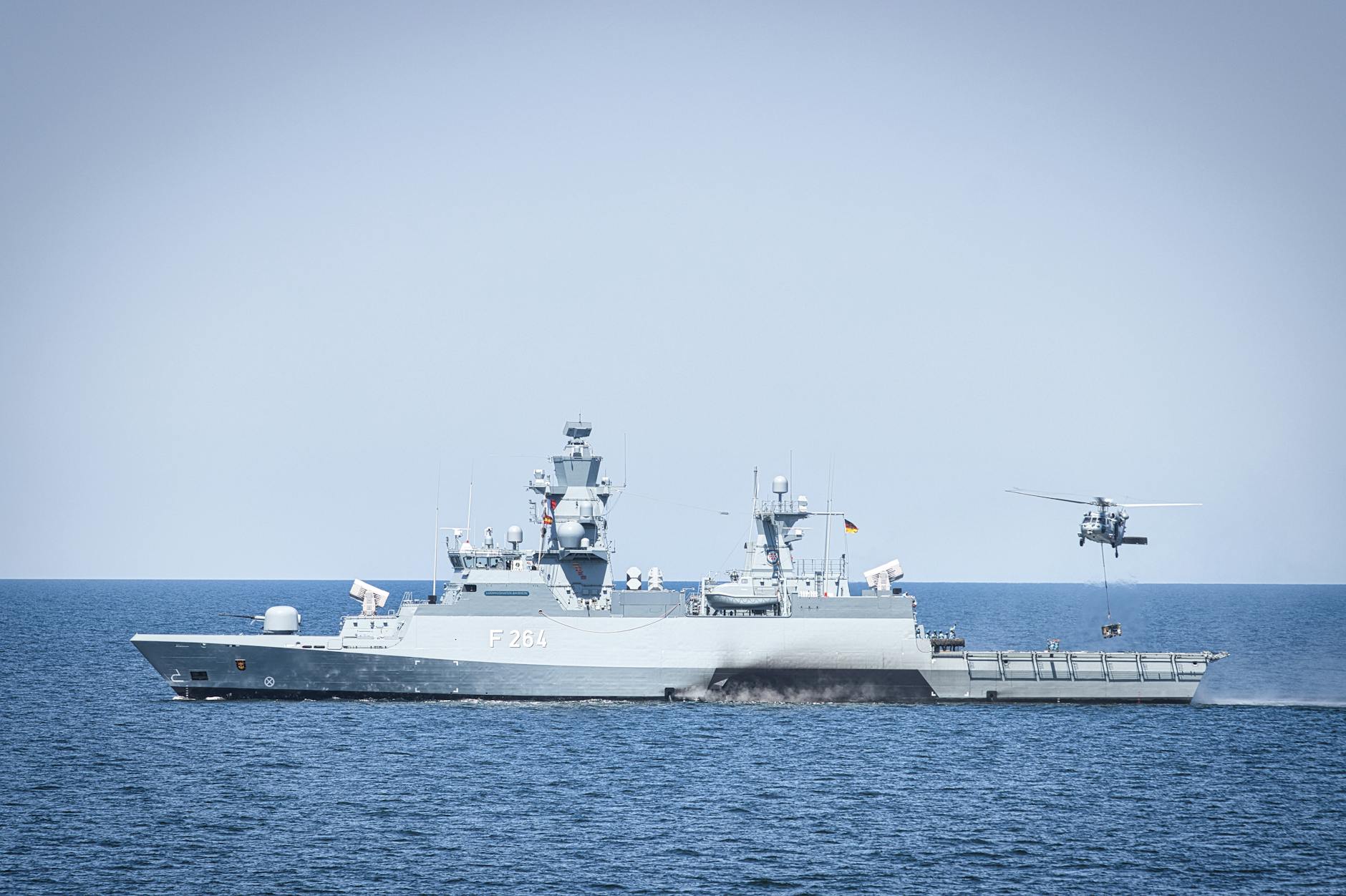
The crews know the numbers. A destroyer-class Aegis ship displaces around 9,000 tons. A THAAD launcher carries multiple interceptors and can be reloaded under combat conditions. Patriot batteries rely on radar, engagement control, and launchers working as one system, not as separate machines. That’s why logistics matters. Fuel, ordnance, spare parts, cooling, power, comms, every piece has to be ready. If one link breaks, the shield bends. If two fail, the shield cracks.
And then there is the psychological layer. Iranian missile sites in central Iran have to assume they are being watched from above, from sea, from orbit, and from the edge of radar range. That changes behavior. It forces hesitation. It forces dispersion. It forces movement. But movement can be tracked. Dispersion can be mapped. And a missile force that cannot mass is a missile force that cannot dominate. Stay with this. The real operation hasn’t even started.
Inside the cockpit and maintenance shelters, the work became almost clinical. Pilots ran checklist items in sequence: power, navigation, datalink, weapons status, fuel balance, fault codes. Technicians verified the firing chain, the guidance package, and the radar modes. Ground crews moved under red lighting, hands on panels, heads down, every motion rehearsed. The engine spool-up hit first with a low mechanical growl, then climbed into a hard metallic roar. Systems came online one by one. Green. Green. Green.
Aegis operators watched the track picture stabilize. Patriot operators confirmed sector coverage. THAAD crews checked battery status and interceptor readiness. Strike package coordination ran across multiple commands, with air defense, intelligence, and air mobility all feeding the same operational map. The atmosphere was total focus. No speeches. No wasted movement. Just combat readiness turning into combat geometry.
The pilots knew what mattered most: timing. If the missiles launched, the window to engage would be measured in seconds, not minutes. If the launchers stayed hidden, the target set would have to be collapsed from above, from below, or from both. And that is why every checklist ended the same way—ready for immediate action, ready for flank speed, ready for the first contact. Every system was green. Every crew was ready. And then—
The first contact came as multiple systems turned at once. Radar screens flickered, alerts tightened, and intercept teams accelerated into action. Alongside the Aegis shield, the THAAD battery was also moving, and Patriot sections were already converging on the same air picture. The strike package did not wait for perfect clarity. It worked with speed, layered pressure, and controlled violence. In one sector, a drone screen surged forward to confirm movement near missile depots. In another, aircraft streaked overhead while ground teams locked onto launch-support vehicles. The whole battlespace erupted into coordinated motion.
Targets in central Iran began to disappear from the map one by one. Hardened positions. Support trucks. Fuel points. Storage sheds. Communications nodes. Some were hit by precision fire. Others were forced to shut down under pressure from the air defense umbrella and the threat of immediate follow-on strikes. The numbers matter here: 300 targets in the broader campaign picture, 14 bases under layered protection, $2.1B in damage already absorbed across the strategic board. That is the scale. Not a raid. Not a warning. A system-level punishment.
And this is the moment the Pentagon wanted every adversary to see. America can move by sea, by air, and on land at the same time. America can defend and strike in the same breath. America doesn’t bluff.
Over the next 72 hours, the pressure only gets sharper. Missile crews in central Iran now have to choose between survival, relocation, and silence. U.S. commanders have already shown the formula: layered defense, rapid movement, and overwhelming reach. Aegis holds the maritime edge. THAAD covers the high end. Patriot seals the gap.
The message is clear. America is not asking. It is imposing terms.